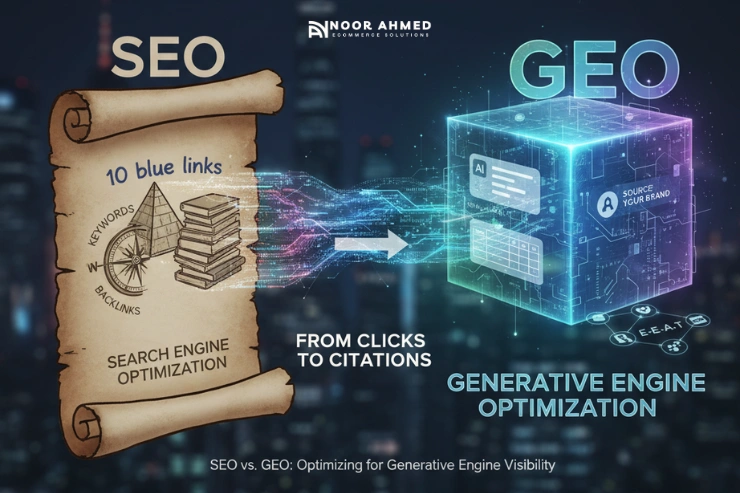
Search Engine was the gold standard for the decades: choose a keyword, develop backlinks, and battle your way up the “10 blue links” list. But let’s be honest, that world is over. The search landscape has been radically reshaped by generative AI, forcing content creators to master an entirely new game:
Generative Engine Optimization (GEO)
This isn’t just about a fresh acronym; it’s a massive shift in how your content actually wins. Today, success isn’t just about earning a click. It’s about making your brand appear in a seamless, AI-generated summary as the reliable, essential source.
🧭 The Core Shift: From Ranking for Clicks to Earning Citations
It refers to the practice of ensuring that your e-commerce site is accessible, functional, and user-friendly across different mobile devices. It involves adjusting elements like the design, layout, and functionality to fit in the smaller screens of smartphones and different tablets. The goal of this activity is to provide a seamless browsing and shopping experience for your mobile consumers, uplifting their usability and encouraging their conversions.
What customers seek and how they acquire it are the main differences between SEO and GEO.
-
- SEO (Traditional Focus): The well-known organic list is your goal; attaining the top ranking, like Position 1, is the aim in order to increase the website traffic. Traffic volume and the keyword searches are used to gauge the success of a website.
- GEO (The New Reality): Your target is the AI-driven response box, like the different AI overviews or the summary. The goal is getting your information selected, synthesized, and cited as the official authority inside that AI-generated answer. You measure success by your brand’s “Share of AI Voice.”
Think about it: When someone asks, “What are the best solar panels for a small home?” The AI immediately delivers a direct answer, usually stitching together bullet points and facts from 3 or 4 highly trusted sources. That summary box? That is the new GEO battlefield.
✅ GEO Strategy: Optimize for AI Trust Signals
The content must yell the authority and the quality in order to succeed in this new generative era. Signals that are AI algorithms are designed to reward.
1. You Must Master E-E-A-T: AI models will always prioritize verifiable, reliable information. Your content must demonstrate its value and go beyond the simple facts.
- Experience: Are you able to demonstrate first hand knowledge?
- Expertise: Was the content written or thoroughly reviewed by a verifiable subject-matter expert with the legitimate credentials? Enhance those author biographies to provide the content.
- Trust: Post the unique result, original data, or the statistics that AI is enabled to locate elsewhere. This unique work makes you a mandatory citation source.
2. Structure Your Content for Easy Extraction: AI models (LLMs) are great at synthesizing, but only if you make it easy for them. They process information much better when the structure is crystal clear.
- Be Direct: Use the “inverted pyramid” method. Answer the single main question of the page immediately in the first paragraph, and then elaborate.
- Write Definitive Headings: Your H2s and H3s shouldn’t be vague. They must be concise, standalone statements that fully summarize the section (e.g., use “How Generative AI Affects Q4 Traffic” instead of just “Conclusion”).
- Don’t Skip Structured Data (Schema): Implement Schema Markup (especially FAQPage and HowTo) to explicitly label your questions and answers. This gives the AI a clean, machine-readable data layer it loves to extract from.
💬 Winning the Conversational Query
People aren’t searching like robots anymore; they’re asking conversational questions, like they’re talking to a chatbot.
3. Focus on Conversational, Long-Tail Queries
Make changes to your previous keyword spreadsheets. Start concentrating on the complete organic queries; ask people to ask or enter into the AI assistants.
- As opposed to the “best CRM software,” choose. What is the most effective CRM software for a 5-person startup?
- Organize your information so that it answers the frequently asked follow-up questions. So transform your one page into a complete knowledge center.
4. Density Compared to Fluff: Clarity Is Everything
High word counts were frequently rewarded by traditional SEO. Clarity, simplicity, and density are rewarded by the GEO.
- Use Lists: An AI can easily synthesize bullet points and numbered lists into the answer summary because they are highly extractable.
- Build Comparison Tables: AI regularly extracts the data from the neatly formatted comparison tables (for example features comparison, pricing). Use these to establish your content as a reliable and impartial source.
Conclusion
The rise of generative AI isn’t the end of SEO; it’s the beginning of its most exciting evolution. The path to lasting digital success requires both: SEO provides the critical site foundation, and GEO ensures your visibility.
You must maintain the technical authority and link structure that traditional SEO demands, but you also have to aggressively restructure your content and enhance those E-E-A-T signals to satisfy AI engines.
By consciously moving your primary focus from merely ranking high to being cited as trustworthy, you guarantee that your content and your brand remain relevant and authoritative in a search landscape increasingly defined by instant, smart answers. The time to optimize for the generative future is now.