Why AI search is reshaping how customers find local businesses, and exactly what you can do today to make sure yours shows up. Picture this: a potential customer types “best bakery near me open Sunday morning” into Google. Instead of scrolling ten blue links, they get a crisp AI-generated answer that names three bakeries by name, with a summary of what makes each one special. Is your business in that answer?
If you haven’t thought about this yet, you’re not alone. But the window to act is now. AI-powered search is no longer a future trend. It is today’s reality, and small businesses that understand it first will have a genuine edge.
What Is AI Search, and Why Does It Matter for Small Businesses?
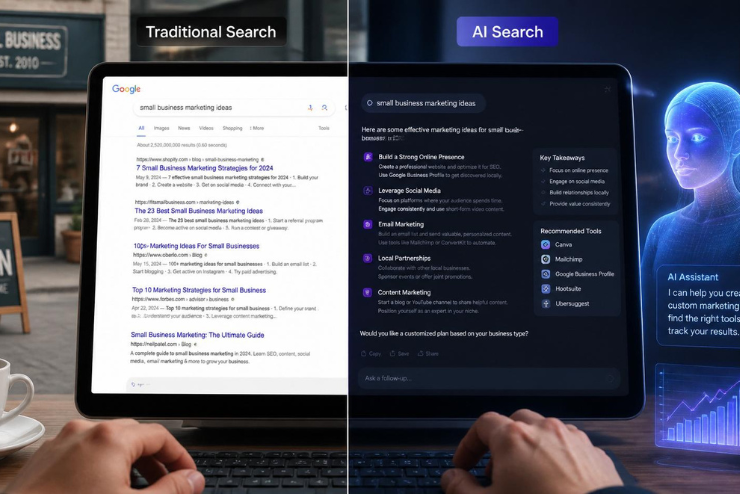
Traditional search shows a list of links. AI search reads, synthesizes, and recommends. Various AI tools pull the information from across the web and package it as a direct, conversational answer.
The shift is significant. AI systems act less like a librarian handing you a card catalogue and more like a trusted friend who says, “I’d go to that place on Main Street; they have great reviews, and they open early.”
- In 2024, 58% of Americans used AI tools to locate local information (2024 Brightlocal).
- 92% of AI overview references come from top-ranked organic websites (Semrush 2024).
- 40% of Gen Z prefers AI-generated results over traditional search (Salesforce 2024).
5 Useful Strategies to Appear in AI Search Results
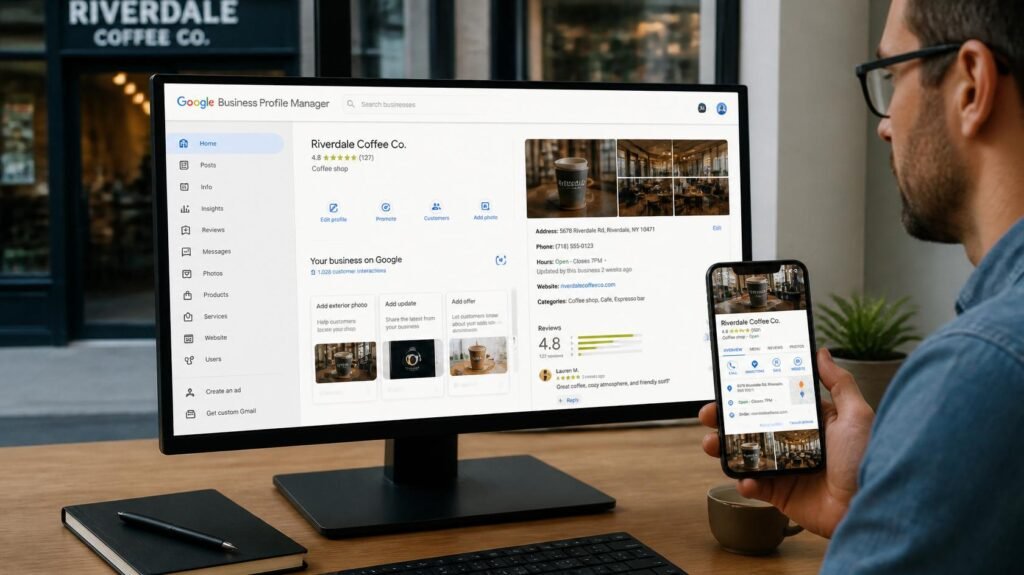
1. Claim and Optimize Your Google Business Profile
The most crucial piece of digital real estate for local AI presence is your Google Business profile (GBP). AI systems frequently pull business names, hours, reviews, and categories directly from GBP when answering local queries.
Verify that your name, number, address, phone number, and working hours are correct and latest. Add pictures on a regular basis. Select the appropriate primary and secondary classifications. Businesses with a complete profile get seven times as many clicks as those with the incomplete ones, according to Google.
2. Write Clear, Factual Content on Your Website
Content that provides the clear and concise answers to particular inquiries is preferred by AI models. You don’t have to be an active blogger, but you need pages that describe what you do, who you serve, where you are, and why clients choose you.
AI would benefit much more from an easy “About Us” page that states, “We are a family-run hardware store in Austin, Texas, specializing in tool rentals and home repair advice from ambiguous marketing material.”
3. Collect and Respond to Customer Reviews
Both humans and AI systems use reviews as a signal of trust. 87% of consumers consider internet reviews before selecting a local business, according to research released by BrightLocal in 2024. When making recommendations, AI search engines often take review sentiment into account.
Request a Google review from happy clients. Reach out to unfavorable ones in a professional manner. A trend of current, sincere reviews indicates to AI algorithms that your company is reliable and active.
4. Use Structured Data (Schema Markup)
A little bit of code called schema markup is added to your website to label your content in a way that is easy for computers to understand. Marking up your company’s name, address, phone number, hours, and product category facilitates the speed instructions of precise data by AI crawlers.
Plugins like Yoast SEO or Rank Math can add schema markup to your WordPress website with little technical work. Basic local business schema is frequently added automatically for Squarespace and Wix.
5. Answer Real Customer Questions in Your Content
Question and answer material is ideal for AI search. Think about what your customers actually ask in store, on the phone, and in emails, and write short, clear answers on your website.
“Do you offer same-day delivery?” “What is your return policy?” “Are you pet-friendly?” A simple FAQ page built from real questions is one of the most effective AI visibility tools available to small businesses today.
Quick win
Open your Google Business Profile right now and check that your hours, phone number, and website URL are correct. This single step takes two minutes and directly improves your AI search visibility.
Common Mistakes to Avoid
- Inconsistent NAP data. Your website, Google, Yelp, and any directory must all have the same name and phone number. AI systems become confused by inconsistency, which can be diminished by trust signals.
Ignoring mobile experience. Mobile devices account for more than 60% of local searches. If your site loads slowly or is hard to use on a phone, AI systems may rank you lower.
- Writing for robots, not people. Stuffing keywords into content reads as low quality to modern AI. Write naturally, for real customers.
- Forgetting to update your profile. A business profile with 2022 hours and no recent reviews signals to AI: this business may no longer be active.
Frequently Asked Questions (FAQs)
No. AI-generated answers are built from organic content on your website, reviews, and business listings. Paid ads appear separately. Strong organic presence is what gets you cited in AI responses.
Changing your Google Business Profile is one example of a change that can affect the outcome within a few days. Content and review signals typically built over 4–12 weeks. Consistency matters more than speed.
They overlap a great deal. The main difference is that AI search prefers straight, concise answers to specific questions. Traditional SEO often focuses on ranking pages; AI visibility focuses on being cited as a trustworthy source within an answer.
A complete Google Business Profile can still get you into AI local results. But even a basic one-page website greatly boosts your visibility and provides AI systems with additional information about your company.